
SCC High Temp 250HT
SCC Wax Wrap 250HT: High-Temperature Corrosion Protection
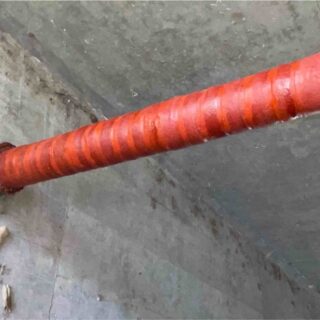
The Industry Benchmark for High-Heat Wax Wrap Technology
SCC 250HT is a high-performance, 70-mil petrolatum-based tape engineered specifically for assets operating in extreme thermal environments. By utilizing a proprietary blend of microcrystalline waxes and petrolatum, SCC 250HT achieves a market-leading operating temperature rating of up to 250°F (121°C).
While traditional high-temperature wraps often become rigid and difficult to manipulate—commonly described by field technicians as “applying cardboard”—SCC 250HT remains exceptionally pliable. This ensures a superior seal even on the most complex geometries.
Contact Us or Sign Up for Online Webinars Here
Superior Performance Through Material Science
The core of SCC 250HT is a non-woven synthetic carrier, fully impregnated with a chemically inert compound of both petrolatum and microcrystalline wax with no VOCs. This unique formulation provides a dual-action defense: an impermeable barrier against moisture and oxygen and a flexible matrix that absorbs substrate vibration and thermal movement.
Key Technical Advantages:
Highest Temperature Rating: With a melt point of 260°F, it provides reliable, long-term protection for high-operating-temp assets reaching 250°F.
Engineered Pliability: Stays conformable during application, allowing for smooth, tight seams and complete wetting of the substrate—even on irregular valves, flanges, and fittings.
Environmental Integrity: 100% VOC-free, odorless, and non-toxic. SCC 250HT is the only product in its class to offer this level of safety and environmental compliance.
Total System Compatibility: Highly dielectric and fully compatible with Cathodic Protection (CP) systems.
Why Field Specialists Choose SCC 250HT
In the field, the success of a coating system depends as much on the ease of application as it does on the chemistry. SCC 250HT eliminates the common “stiffness” associated with high-heat tapes.
Pliable Material Ensures Impervious, Gap-Free Sealing
Because the material remains more pliable throughout the wrapping process, installers can achieve an impervious seal to outside elements without the gaps or “tenting” often found in stiffer competitor products. It is the solution the industry has been seeking: the rugged durability of a high-heat barrier combined with the ease of a standard wax wrap.
Designed for Minimal Surface Preparation
Industry Note: SCC 250HT is designed for use on minimally prepared surfaces (SSPC SP-2 or SP-3), making it an ideal choice for remediation projects where abrasive blasting is not feasible.
Technical Specifications
| Property | Value |
|---|---|
| Max Operating Temp | 250°F (121°C) |
| Melt Point | 260°F (127°C) |
| Thickness | 70 mils |
| Composition | Microcrystalline / Petrolatum Blend |
| VOC Content | 0% (VOC Free) |
| Carrier | Non-woven synthetic fiber |
| Application | Hand-applied; highly conformable |